
Read the care label, separate the curtain from its liner, and clean each piece according to its actual material and finish. A washable cotton curtain, a coated polyester liner, and a wipe-clean PEVA sheet can hang on the same rod but need three different routines. Remove hooks, use only compatible cleaning products, rinse thoroughly, and dry using the method on the label.
Start with the gentlest permitted method. A hotter wash or stronger cleaner is not automatically more effective—and can shrink fabric, damage coatings, or distort plastic.
Before you clean: identify what is actually hanging in your shower
Take down the outer curtain and inner liner separately. Look for a sewn-in care label, printed instructions along an edge, the original packaging, or the manufacturer's page for the exact model. Photograph the instructions so they remain available after the label fades. Check both pieces of a set: “machine washable” on a listing may describe the outer panel rather than every component.
Read composition and construction together. “Waffle,” “linen-look,” “hotel-style,” and “fabric” do not identify a fiber. A linen-look panel may be polyester; waffle cloth may be cotton or a blend. A polyester liner may also have a waterproof finish whose cleaning limits differ from those of an uncoated decorative panel. Use the label for the selected variation rather than instructions for a similar-looking product.
- Textile panel: check fiber percentages, wash cycle, maximum temperature, bleaching restrictions, and drying symbols.
- Sheet-style liner: check whether it is PEVA, EVA, PVC/vinyl, or another material, and whether the maker permits machine washing at all.
- Integrated set: detach a removable liner only as instructed. Built-in rings, mesh windows, magnets, and decorative trim may change the routine.
- No readable label: identify the model before using the washer, dryer, stain remover, or bleach. Do not treat an unknown panel as ordinary laundry.
This guide offers a decision process, not a replacement for the care instructions supplied with your curtain.
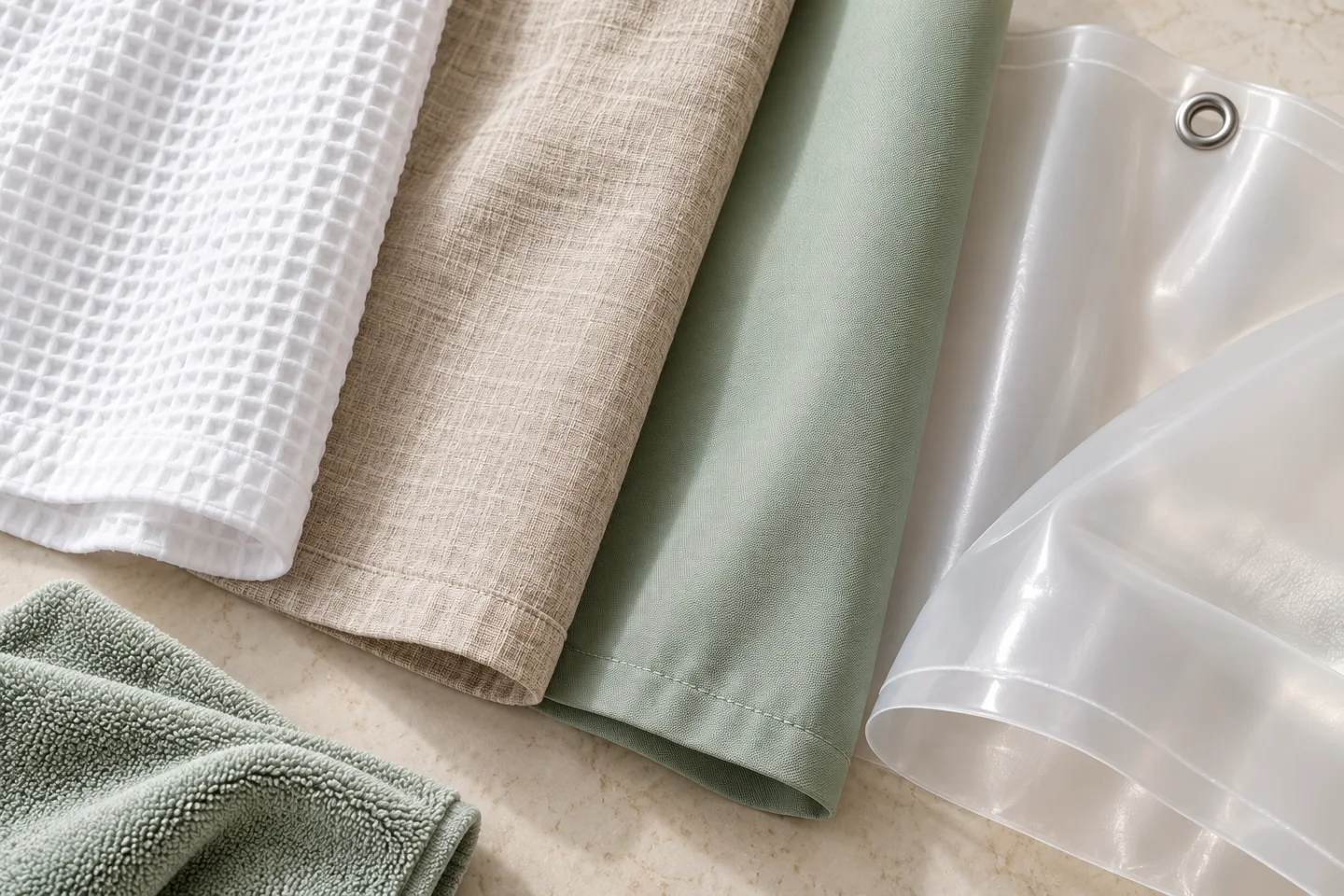
Material-by-material cleaning reference
These are starting points for checking the label, not universal washing settings. Follow a stricter product instruction whenever it differs.
| Material or construction | Check before cleaning | Main thing to avoid |
|---|---|---|
| Polyester fabric | Washability, coating, drying method | Assuming every polyester liner can tumble dry |
| Cotton | Temperature, shrinkage guidance, color care | Hot laundering to force out a stain |
| Cotton blends | All fibers, trim, finish, and complete care label | Choosing settings from the cotton percentage alone |
| Linen and linen blends | Machine versus professional cleaning; drying and ironing limits | Wringing, over-drying, or ironing a coated backing |
| PEVA and EVA | Wipe-clean directions; any machine-wash permission | Heat and abrasive scrubbing |
| PVC/vinyl | Exact plastic type, cleaner compatibility, wash permission | Assuming “vinyl” means the same care as every plastic liner |
| Waffle, mesh, lace, printed or coated panels | Underlying material plus vulnerable details | Treating a texture or style name as a care instruction |
Prepare the curtain and your cleaning space
Use a clean tub, basin, or laundry area with enough room to support the panel. A gritty surface can scratch a liner while you wipe it. Set aside a soft cloth, suitable detergent or the maker's specified cleaner, and the label instructions. Open ventilation as appropriate for the room and cleaning product.
- Remove ordinary hooks and rings. Put loose hardware in a container. Leave sewn-in weights, bonded magnets, and built-in rings in place unless the maker says they are removable.
- Inspect the edges and fittings. Look for split plastic, loose grommets, peeling finishes, fraying seams, and stretched holes. A weakened panel can tear further during laundering.
- Identify the problem. Loose soap residue needs a different approach from a persistent stain or damaged coating. Color alone does not identify what a mark is.
- Test a compatible cleaner discreetly. Check for color transfer, whitening, tackiness, or changes in sheen. A test does not override a “do not use” instruction.
- Separate cleaning tasks. Clean hooks and the rod using their own finish-compatible instructions rather than washing metal hardware with the curtain.
How to clean a polyester shower curtain or fabric liner
Polyester appears in decorative panels, microfiber fabrics, waffle curtains, and water-containing liners. The fiber name alone does not settle the cleaning method. In particular, a liner's coating or backing may rule out bleach, ironing, or tumble drying even when another polyester curtain allows them.
For a machine-washable polyester panel
- Remove detachable hardware and separate any liner or accessories.
- Treat a small dirty area only with a product the label permits, following its contact-time and rinsing instructions.
- Select the stated cycle and water temperature. Measure detergent for the load and washer; excess detergent can leave a film rather than improve cleaning.
- Leave enough room for the panel to move. Follow the washer manual and curtain instructions about load size; do not automatically add towels to every load.
- Remove promptly and dry exactly as directed. Rehang only where drips can drain into the tub or tray without wetting the floor.
A useful example of product-specific limits is The Company Store's polyester fabric liner: its instructions specify a cold gentle wash, a separate load, no bleach, hanging to dry, and no ironing. Those restrictions apply to that liner, not every polyester curtain. See the manufacturer's care instructions.
If the panel is coated or its label says wipe clean
Use the specified hand-cleaning method instead. Support the material, wipe gently, and rinse away cleaner as directed. Do not try to restore water repellency with fabric softener, an iron, or an aftermarket spray unless the curtain maker specifically approves the treatment. Inspect for peeling or cracking after cleaning.
How to clean a cotton shower curtain
A cotton outer panel can absorb water, so its drying routine matters as much as its wash. Keep it arranged with the liner as the manufacturer intends; washing will not turn a decorative curtain into a waterproof barrier.
- Check whether the panel is washable and note any color, bleaching, or shrinkage restrictions.
- Remove hardware and gently address localized marks with a permitted product. Do not scrub embroidery or printed areas aggressively.
- Wash at the label's temperature and cycle with compatible colors. Avoid transferring dye from new towels or other laundry.
- Use the stated drying method and remove promptly. If line drying is allowed, support and arrange the curtain evenly; if tumble drying is allowed, follow the temperature limit.
- Once dry, check the finished length and rehang with the intended clearance. Do not stretch a shrunken panel by adding weights.
For example, The Company Store's Company Cotton woven curtain specifies a cold gentle wash with like colors, no bleach, low tumble drying, and warm ironing if needed. A different cotton panel may have different limits. Check this cotton care example.
Measure an unfamiliar curtain before its first wash if fit is tight. If it becomes too short, recheck the care label and dimensions instead of immediately lowering a fixed rod or pulling on wet seams. Use a liner suitable for the actual opening rather than accepting gaps.
How to clean cotton-blend shower curtains
A blend should be treated as a complete finished product. Cotton combined with polyester, linen, or another fiber can behave differently from pure cotton; percentages alone do not tell you whether the dyes, trim, or backing tolerate a particular treatment.
Use the labeled washing and drying sequence rather than averaging the care rules for the individual fibers. If the label gives separate instructions for a decorative face and removable backing, clean them separately. Avoid a hotter cycle simply because one component seems durable. Examine the hem after drying: uneven shrinkage or puckering can affect how the panel hangs.
If you cannot find the complete composition, ask the seller or manufacturer for the exact model's care instructions before machine washing. “Cotton feel” is a description of texture, not confirmation that a panel is cotton or a cotton blend.
How to clean linen and linen-blend shower curtains
Read the full composition first: real linen, a linen blend, and polyester with a linen-like texture belong to different care decisions. A textured weave is also not a reason to assume a curtain needs dry cleaning. Follow the finished panel's label.
- Check whether the panel is machine washable, hand washable, or professional-clean only.
- For a washable panel, remove hooks and use the specified detergent, temperature, and cycle. Avoid twisting or wringing wet fabric.
- Support the wet panel while lifting it. Smooth it gently into its intended shape without pulling at the hanging holes.
- Dry by the permitted method and stop at the appropriate point. Do not increase heat to remove creases.
- Iron only when allowed, at the indicated setting, avoiding coatings, plastic details, and decorative elements that cannot tolerate it.
The Company Store's washed-linen shower curtain is one example with a cold gentle wash, low tumble drying, and warm ironing permitted; it also restricts optical brighteners and chlorine bleach. These details show why a generic “linen wash” rule is incomplete. Read the washed-linen instructions.
A relaxed linen texture does not need to be pressed perfectly flat to look finished. More useful checks are whether it is fully dry, hangs freely, and still fits the intended curtain-and-liner arrangement.
How to clean PEVA and EVA shower-curtain liners
Do not assume a plastic sheet belongs in the washing machine. Some manufacturers specify hand wiping only. AmazerBath's lightweight PEVA liner, for instance, calls for a damp-cloth wipe and drying fully between uses. SlipX Solutions advises against machine washing its liners because thinner material can be damaged. AmazerBath care example · SlipX Solutions cleaning guidance.
A gentle wipe-clean routine, when the maker permits it
- Take the liner down or position it so you can reach both sides safely without pulling on its holes.
- Lay it on a clean, smooth surface or drape it over the tub edge. Avoid sharp folds around grommets and weights.
- Start with a soft damp cloth. Use a cleaner only if it is suitable for the exact liner and permitted by its instructions.
- Work in small areas, giving attention to folds and the lower edge. Use light pressure; avoid scouring pads and stiff brushes.
- Rinse away residue as directed, then rehang so water drains into the tub and the sheet can dry without sticking to itself.
Quiet Town's EVA care guide illustrates a different approved routine: it specifies a particular gentle spray cleaner and a soft brush, followed by rinsing and hanging to dry. Its product guidance also cautions against extreme heat. That is a model-specific method, not permission to use any spray on any PEVA or EVA liner. Read Quiet Town's EVA cleaning guide.
Do not use a dryer, iron, steamer, boiling water, or a hot radiator to speed drying unless the exact manufacturer instructions explicitly allow the method. Replace a liner that has torn holes or surface breakdown instead of trying to scrub it back into shape.
How to clean vinyl or PVC shower curtains
“Vinyl” is used loosely in retail descriptions. Confirm the listed composition and model before borrowing instructions for PEVA, EVA, or PVC. Thickness, printing, seams, and attached weights can also affect what the finished liner tolerates.
Use a soft cloth and the manufacturer's cleaning method first. Work on both faces, especially where the lower edge folds or touches the tub. If machine washing is explicitly allowed, use the stated cycle, temperature, load guidance, and drying method. If it is not allowed—or the instructions are missing—do not use a general internet tip as permission.
A cleaner labeled for bathroom surfaces is not necessarily suitable for a flexible printed liner. Check the cleaner's permitted surfaces and the curtain instructions together. Keep concentrated products off metal grommets unless their finish is approved for that exposure. Stop if the surface becomes tacky, cloudy, brittle, or begins losing print.
Waffle weave, microfiber, lace, mesh, and other special details
Texture is not material. Use the cotton, polyester, or blend instructions that match the composition, then account for the construction. Deep waffle pockets need thorough rinsing and drying. Microfiber is a fine-fiber construction rather than a complete care specification. Lace, embroidery, tassels, and mesh can catch on hooks or rough laundry.
Remove detachable pieces only when intended, and use a laundry bag if the product instructions call for one. Do not force an integrated ring through the fabric or remove a sewn-in magnet. Wash a snap-in liner separately only as its instructions direct, then match the snaps carefully during reassembly; pulling a misaligned liner can damage the attachment points.
If a panel has an unfamiliar specialty fiber, a laminate, or a “professional clean only” label, follow that guidance rather than adapting one of the generic methods above. A fabric-looking surface can conceal a less washable backing.
Explore waffle-weave shower curtains → Check each product's fiber content before choosing a cleaning method.
Soap film, mineral marks, discoloration, and persistent stains
Start with residue, not a stronger chemical
Rinse away loose residue and use the mild, material-compatible method first. Pay attention to the bottom fold and overlapping surfaces. If you can feel a slippery layer, more detergent may worsen the problem; thorough rinsing is important. A clear liner can retain some water marks after cleaning without being physically damaged.
Do not identify a stain by color alone
Pink, orange, gray, or dark spots can have different causes. A photograph or the color of a mark cannot reliably distinguish mineral staining, transferred dye, residue, or microbial growth. A home treatment should not be assumed to disinfect a curtain simply because a stain fades. Cleaning removes soil; disinfection requires a product labeled for the intended use, a compatible surface, and its complete directions.
Bleach and descalers are conditional, not default steps
Use chlorine bleach, oxygen bleach, or a mineral-removal product only when both the curtain and cleaning-product instructions permit it. White fabric is not automatically bleach-safe. Use the current product label for dilution, application, contact time, rinsing, protective equipment, and ventilation; this guide intentionally does not give a one-size-fits-all chemical recipe.
Never mix chlorine bleach with vinegar, other acids, ammonia, or other cleaning products unless the product label explicitly directs the combination. Do not combine leftover cleaners in a basin or spray bottle. Clorox cautions against mixing bleach and ammonia and instructs users to follow product directions. Read the manufacturer's chemical-mixing warning.
If a compatible cleaning cycle leaves a stain, check the product instructions before repeating treatment. Continued scrubbing is a poor trade when it removes a finish or weakens the hem. For extensive recurring growth or persistent odor in a damaged panel, replacement and attention to the room's moisture conditions may be more practical than stronger treatment.
Drying and rehanging: finish the job properly
Rinse until permitted cleaning products are removed, then use the label's drying method. Do not let a clean panel sit folded in a washer or bucket. If hanging to dry is permitted, spread it without stretching and direct drips into the tub or tray. Keep wet material off a painted wall, wood vanity, and the bathroom floor.
Before reattaching the curtain, clean compatible hooks and the rod, check for sharp or corroded points, and count the attachment positions. Reinstall the outer panel and liner in their intended positions. Check that the liner directs water inside the tub or tray and that neither layer is dragging or pooling at the bottom. Follow the product and shower setup's clearance guidance rather than a universal floor-gap measurement.
Let both faces dry. Avoid leaving a liner stuck against a wet outer curtain or bunched in a corner. A panel that looks clean but stays wet inside its folds is not ready for folded storage.
A manageable cleaning and prevention routine
There is no single wash interval that suits every shower. Use frequency, ventilation, water conditions, and the material's care limits to decide. As a practical starting routine, inspect the lower edge and folds weekly and clean when film, odor, or buildup appears—or sooner if the maker specifies an interval. In a heavily used or slow-drying shower, inspect more often.
- After showering: arrange the curtain so it can dry, keep it from bunching tightly, and use the room's intended ventilation.
- During regular bathroom cleaning: inspect both faces of the liner, the hem, grommets, hooks, and the contact area at the tub.
- When buildup appears: follow the permitted cleaning method before residue becomes harder to remove. Do not wait for a scheduled date if the panel is already dirty.
- Before storing a spare or seasonal curtain: clean it as directed and let it dry completely. Store it away from damp surfaces and keep its care information.
A spare compatible liner can simplify laundry days, but match its dimensions and attachment system. A clean replacement that does not fit is not an improvement.
When cleaning is no longer the best option
Inspect function as well as appearance. Torn hanging holes, split seams, detached weights, cracking plastic, peeling coatings, and a liner that no longer contains water are reasons to reassess the item. Persistent odor or recurring extensive staining after the permitted cleaning routine also calls for a closer look at the panel and bathroom moisture.
Do not use adhesive, extra heat, or an unapproved coating to conceal a failing water barrier. Replace a damaged liner with one that fits, then address why it stayed wet or rubbed against a sharp fitting. If a separate outer curtain remains in good condition, you may be able to replace only the liner rather than the whole set. Check snap-in compatibility before ordering.
Shower-curtain cleaning FAQs
Can every shower curtain go in the washing machine?
No. Some textile panels are washable, while some coated fabrics and sheet liners require wiping or another specified method. Check each component separately.
Can I wash the curtain and liner together?
Only when both manufacturers' instructions and your washer's load guidance allow compatible settings. Separate them when materials, colors, finishes, or drying instructions differ.
Should I add towels to scrub a plastic liner?
Do not assume so. Some liner makers prohibit machine washing entirely. Added towels do not make an unapproved wash method suitable. Follow the exact liner and washer instructions.
Can I put a plastic liner in the dryer for a few minutes?
Do not do this unless the maker explicitly permits it. Use the stated drying method; brief exposure is not a guarantee against heat damage.
Is vinegar the safest cleaner for every curtain?
No. Compatibility depends on the material, finish, and hardware. Do not assume an acid is suitable simply because it is a household ingredient, and never combine it with chlorine bleach.
Does “mildew-resistant” mean I can skip cleaning?
No. Follow the maker's maintenance instructions. A resistance claim is not a promise that residue never accumulates or that the curtain can remain wet indefinitely.
What if the care label is missing?
Find the exact model's instructions or contact the manufacturer before using heat, chemicals, or a washing machine. Do not substitute instructions for a similar-looking curtain.
Can I iron a shower curtain to remove wrinkles?
Only if the label permits ironing, at its stated setting. Do not iron plastic liners, coatings, or integrated plastic details by assuming they share the face fabric's heat tolerance.
Find a shower curtain by material
Compare each product's actual composition and care instructions before buying. Our material collections help narrow the choices; membership is not a guarantee that every product has the same cleaning routine.
Make a care plan for the actual components
Build a component checklist
List the decorative panel, liner, rings and any detachable trim. Copy the care method for each piece before starting. “Machine washable” in a title may apply to only one component.
Keep instructions tied to the model
Quiet Town publishes specific cleaning instructions for its Sun Shower product. Those instructions are an example of model-specific guidance, not a universal recipe for every vinyl, EVA, PEVA or coated-fabric curtain.
Know when evidence is missing
If a retailer field contains a price or conflicts with the feature description, it is not a care instruction. Use the supplied label or manufacturer guidance. Do not infer heat, bleach or tumble-dry permission from material alone.
Worked examples and comparison framework: Bathroom Design Hub editorial analysis, reviewed October 31, 2026. No hands-on performance or installation test is claimed.
References for exact-product context: Quiet Town: cleaning a Sun Shower curtain
Prepared by Bathroom Design Hub. We compare source specifications and explain practical decisions; seller claims remain attributed. Our examples are calculations, not product test results. Read our editorial method
Sources and care references
Written by Bathroom Design Hub. Reviewed October 21, 2026. The step-by-step decision process and maintenance checklist are editorial guidance. The manufacturer references below provide specific examples; use your own product's label when it differs.
- The Company Store: polyester fabric liner care
- The Company Store: cotton woven curtain care
- The Company Store: washed-linen curtain care
- AmazerBath: lightweight PEVA liner care
- SlipX Solutions: shower-liner cleaning FAQ
- Quiet Town: EVA curtain cleaning
- Clorox: bleach and ammonia warning
Illustrations were created for this guide and do not depict tested products. Our product collections contain affiliate links. As an Amazon Associate we earn from qualifying purchases.